
Efficient Sludge Dewatering for Municipal and Industrial Wastewater Treatment
Sludge management is one of the most important challenges faced by modern wastewater treatment plants. After biological, chemical, or physical treatment, wastewater plants generate large quantities of sludge that must be efficiently dewatered before transportation, disposal, reuse, or further treatment.
For overseas wastewater treatment plants looking for a compact, continuous, and reliable sludge dewatering solution, the GN 14-inch sludge dewatering decanter centrifuge provides an effective option.
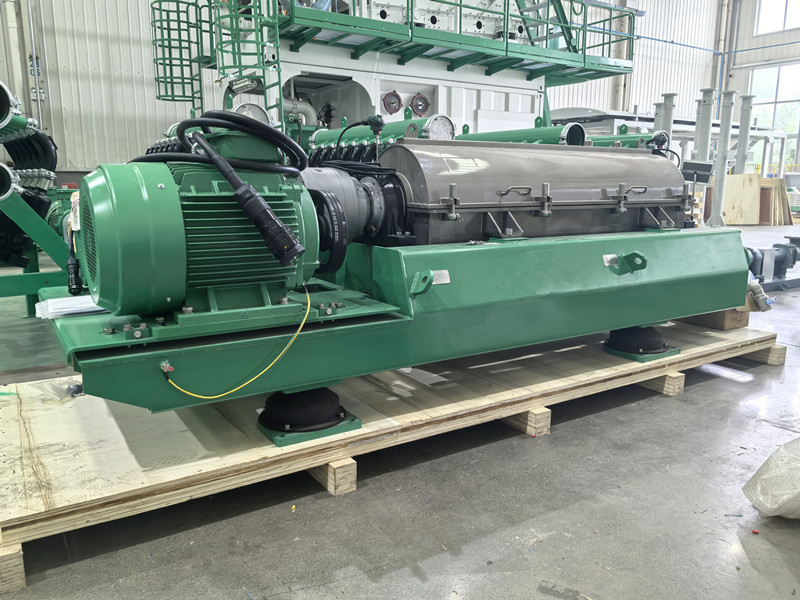
The GN GNLW-364GT is a high-speed horizontal screw decanter centrifuge with a 360 mm bowl diameter, equivalent to approximately 14 inches. It is specifically designed for dewatering applications where reducing sludge volume and increasing discharged solids dryness are key objectives.
Why Use a Decanter Centrifuge for Sludge Dewatering?
Traditional sludge dewatering equipment, such as belt filter presses and screw presses, can be effective in many applications. However, wastewater treatment plants may require higher throughput, continuous operation, a smaller footprint, or more automated operation.
A decanter centrifuge separates solids and liquids using centrifugal force. Sludge is continuously fed into the rotating bowl, where the heavier solid particles settle against the bowl wall. A rotating screw conveyor continuously transports the separated solids toward the discharge end, while clarified liquid flows out from the opposite side.
This continuous separation process allows the centrifuge to operate without frequent interruption for solids removal.
For sludge containing a high proportion of fine particles, polymer conditioning is normally used before centrifugation. The polymer causes fine suspended particles to agglomerate into larger flocs, making them easier to separate from the liquid phase.
GN 14-Inch Decanter Centrifuge: GNLW-364GT
The GNLW-364GT belongs to GN’s T Series dewatering decanter centrifuges.
The main specifications include:
- Bowl diameter: 360 mm (approximately 14 inches)
- Bowl length: 1,520 mm
- Maximum bowl speed: 3,964 RPM
- Maximum centrifugal force: 3,200 G
- Bowl length/diameter ratio: 4.2
- Main motor: 22 / 30 / 37 kW
- Back-drive motor: 7.5 / 11 kW
- Beach angle: 8.5°
The actual processing capacity depends strongly on sludge characteristics, including solids concentration, particle size distribution, viscosity, specific gravity, polymer type and dosage, and the required separation performance. Therefore, the final capacity should always be confirmed based on the specific sludge conditions.
Designed for Maximum Dewatering
The GN T Series uses an 8.5-degree beach angle. This geometry provides a relatively long dewatering section inside the centrifuge, allowing separated solids to remain in the dewatering zone for longer before discharge.
The objective is to achieve a higher solids dryness rather than simply maximizing liquid clarity.
This makes the GNLW-364GT particularly suitable for wastewater applications where reducing the amount of water carried out with the sludge is important.
Drier discharged sludge can provide several benefits:
- Reduced sludge transportation costs
- Lower disposal volume
- Easier handling and conveying
- Reduced downstream treatment requirements
- Improved overall sludge management efficiency
Application in Overseas Wastewater Treatment Plants
GN dewatering decanter centrifuges can be applied to a wide range of wastewater and sludge treatment processes, including:
- Municipal wastewater treatment plants
- Industrial wastewater treatment plants
- Food processing wastewater
- Chemical wastewater
- Mining wastewater
- Construction wastewater
- Water treatment plant sludge
- River and lake dredging sludge
- Organic wastewater
- Oily sludge and other difficult-to-handle sludge streams
For international projects, the centrifuge can also be integrated into a complete sludge dewatering system, including sludge transfer, polymer preparation and dosing, flocculation, centrifuge separation, solids conveying, and filtrate collection.
Polymer Dosing and Sludge Conditioning
Fine sludge particles are often difficult to separate directly because they remain suspended in water.
A polymer dosing system can be installed upstream of the centrifuge to condition the sludge. The polymer binds fine particles together and forms larger flocs, which can then be more efficiently separated by centrifugal force.
The optimal polymer type and dosage depend on the characteristics of the incoming sludge. In practical wastewater treatment projects, a jar test or laboratory test is recommended to determine the appropriate polymer before finalizing the dosing system.
GN can also provide integrated chemical dosing equipment as part of a complete sludge dewatering solution.
Compact Design and Continuous Operation
One of the major advantages of a decanter centrifuge is its continuous operating principle.
Unlike batch-type dewatering processes, the centrifuge can continuously receive sludge, separate solids from liquid, and discharge dewatered solids.
The GNLW-364GT also uses a compact two-motor arrangement, with the main motor and back-drive motor positioned at the same end of the machine. This helps reduce the overall footprint and simplifies equipment layout within a wastewater treatment plant.
For overseas projects where available installation space is limited, this compact configuration can be particularly advantageous.
Reliable Construction for Long-Term Operation
Wastewater sludge can be abrasive and corrosive, making material selection and wear protection important considerations for long-term operation.
GN’s dewatering centrifuges use stainless-steel materials for major rotating components, with options including duplex stainless steel. Wear-prone areas can be protected using hard alloy materials.
The solids discharge area can be equipped with tungsten carbide wear protection, while replaceable wear-resistant components help simplify maintenance and extend service life.
The screw conveyor can also be fitted with replaceable wear-resistant alloy protection according to the characteristics of the application.
High-Speed Dynamic Balancing
A decanter centrifuge operates at several thousand revolutions per minute. Dynamic balance is therefore critical for safe and stable operation.
GN performs multiple dynamic balancing processes on the main rotating components, including balancing at medium speed, balancing at the actual operating speed, and final machine balancing.
The objective is to minimize vibration and maintain stable operation under high-speed conditions.
Intelligent Monitoring and Automatic Protection
Modern wastewater treatment plants increasingly require automated equipment that can be integrated into centralized plant control systems.
The GN decanter centrifuge can be equipped with an electrical control system incorporating PLC, HMI, and variable frequency drive technology.
Operating parameters such as:
- Bowl speed
- Bearing temperature
- Vibration
- Main motor current
- Back-drive motor current
- Screw torque
- Lubrication conditions
can be monitored during operation.
The system can also provide alarms and automatic protection against abnormal operating conditions such as overload, phase loss, short circuit, or excessive torque.
Selecting the Right Decanter Centrifuge for Your Wastewater Plant
A 14-inch centrifuge can be an excellent solution for many small- and medium-scale wastewater sludge dewatering applications. However, selecting a centrifuge should never be based on bowl diameter alone.
Before recommending the final model, the following information should normally be considered:
- Sludge flow rate – m³/h
- Dry solids loading – kg/h
- Feed solids concentration – %
- Sludge density
- Particle size distribution
- Organic and inorganic content
- Sludge viscosity
- pH and temperature
- Required cake dryness
- Required centrate clarity
- Polymer type and dosage
- Available electrical power supply
For example, two wastewater plants may both have a sludge concentration of 3%, but their required centrifuge capacities can be significantly different because of differences in sludge characteristics and required separation performance.
A Complete Sludge Dewatering Solution
For overseas wastewater treatment projects, GN can provide more than the centrifuge itself.
A complete sludge dewatering package can include:
Sludge Feed → Polymer Preparation → Polymer Dosing → Flocculation → Decanter Centrifuge → Dewatered Sludge Conveying → Centrate Collection
This integrated approach allows the equipment to be designed around the complete treatment process rather than treating the centrifuge as an isolated machine.
Depending on project requirements, the system can also be configured with automated control, skid-mounted equipment, containerized solutions, and customized electrical systems for different international markets.
Conclusion
The GN GNLW-364GT 14-inch sludge dewatering decanter centrifuge offers a compact and continuous solution for wastewater treatment plants that require efficient sludge dewatering.
With a 360 mm bowl diameter, maximum speed of 3,964 RPM, centrifugal force up to 3,200 G, 8.5-degree beach angle, and 22–37 kW main motor options, the centrifuge is designed to provide high-performance solid-liquid separation while maintaining a compact footprint.
For overseas municipal and industrial wastewater treatment plants, the key is not simply selecting a centrifuge with the largest capacity. The equipment should be properly matched to the sludge characteristics, solids loading, required cake dryness, centrate quality, and overall plant configuration.
GN can evaluate the sludge characteristics and recommend a suitable decanter centrifuge and complete sludge dewatering system based on the actual project requirements.